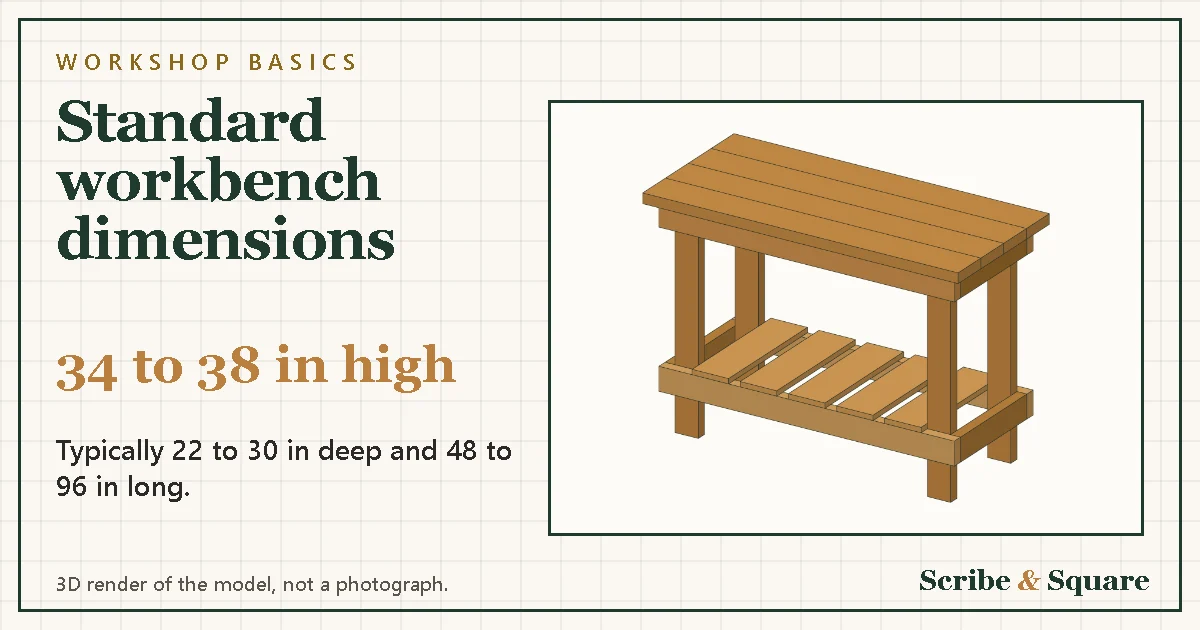
Most workbenches are 34 to 38 in high, 22 to 30 in deep and 48 to 96 in long. To find your height, measure from the floor to your wrist crease while you stand with your arms hanging.
The right workbench size depends on your height, the work you do and the space you have. The numbers below are the usual starting points, plus a simple way to find the height that fits you.
Standard workbench dimensions
| Dimension | Typical range | In mm |
|---|---|---|
| Height | 34 to 38 in | 865 to 965 mm |
| Depth | 22 to 30 in | 560 to 760 mm |
| Length | 48 to 96 in (4 to 8 ft) | 1220 to 2440 mm |
| Top thickness | 1 1/2 in or more | 38 mm or more |
These are common ranges, not rules. A small garage bench can be shorter and shallower, and a bench for heavy work can be longer and thicker.
How high should a workbench be?
The top is comfortable when you can work without hunching or lifting your shoulders. Two simple rules of thumb:
- General work and assembly: about the height of your wrist when your arm hangs at your side. For most adults this lands between 34 and 38 in.
- Hand planing and sawing by hand: a little lower, so you can put your body weight into the tool. Around 32 to 35 in suits many people.
- Fine detail work: a little higher, closer to elbow height, so your eyes are nearer the work.
How to measure yours: stand straight in the shoes you work in, let your arms hang, and measure from the floor to your wrist crease. Use that number as your finished height, including the top. Remember that the top adds thickness: a 1 1/2 in top on 32 1/2 in legs makes a 34 in bench.
How deep and how long?
- Depth: 24 in is a good all-round depth. Deeper than about 30 in makes it hard to reach the back. If space is tight, 22 in still works for most small projects.
- Length: 48 in is the practical minimum for a bench you can clamp a board to. 60 to 72 in gives room for a project and your tools.
Legs and top: what size lumber?
Use actual lumber sizes for your math. A 2x4 is 1 1/2 in x 3 1/2 in. For a light to medium bench, doubled 2x4 legs and a top made of 2x4s or 2x6s laid flat are strong and cheap. For a heavy bench, 4x4 legs (3 1/2 in x 3 1/2 in) add stiffness. Brace the frame with rails near the top and bottom so it does not rack, and check it is square before you tighten the screws.
A compact bench plan with the numbers worked out
Our Compact Workbench (plan PS-10) measures 47 1/2 in wide, 22 in deep and 34 in high (1207 x 559 x 864 mm). It is built from construction pine or fir 2x4, 2x6 and 1x6, and the plan gives the shopping list, a cutting diagram and the exact diagonals to check as you build. See the details on the Compact Workbench plan page. Our plans are modeled and checked in 3D and have not yet been built and tested.
Frequently asked questions
What is the standard height of a workbench?
Most workbenches are between 34 and 38 inches high. A good starting point is the height of your wrist when your arm hangs at your side.
How deep should a workbench be?
About 24 inches is a good all-round depth. Much deeper than 30 inches is hard to reach across, and 22 inches works well for a small garage bench.
How long should a workbench be?
At least 48 inches for a bench you can clamp a board to. Between 60 and 72 inches gives room for a project and tools.
What size lumber should I use for workbench legs?
Doubled 2x4 legs are strong enough for light to medium benches. 4x4 legs add stiffness for heavy work.
Build a compact workbench
Plan PS-10 has the shopping list, a cutting diagram and the Square Checks, so the bench comes out flat and square.
See the plan