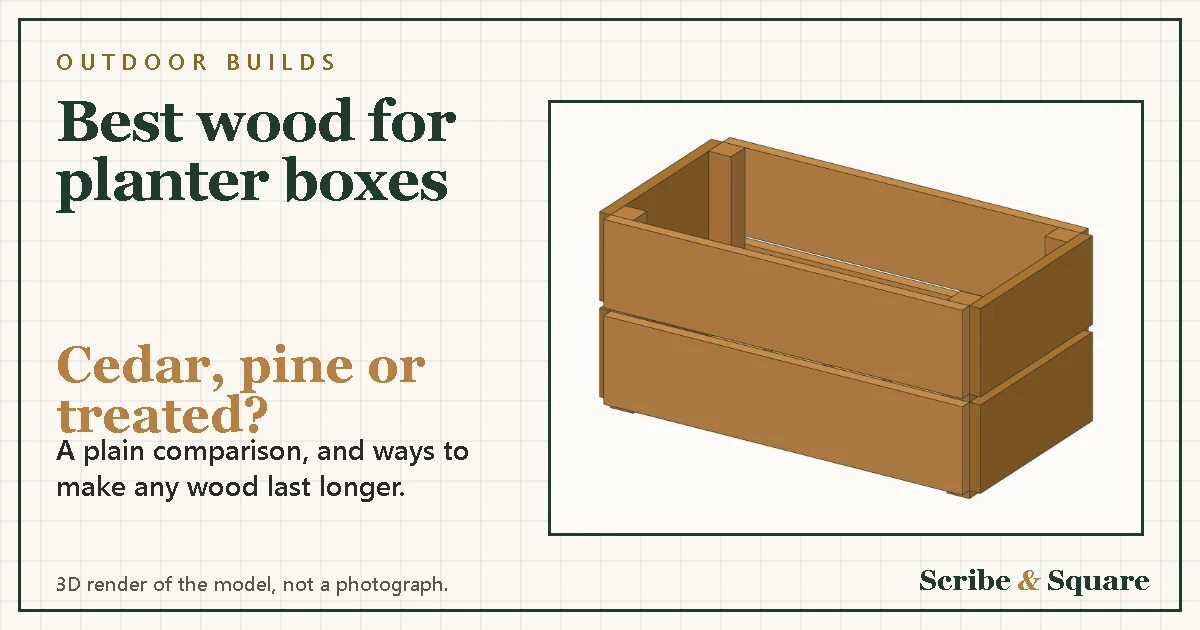
Cedar and redwood resist rot best naturally. Untreated pine is the cheapest but rots faster in wet soil. Lining the box, lifting it off the ground and using exterior screws helps any wood last longer.
Wood in contact with soil and water will rot sooner or later. The question is how long it lasts, what it costs and whether it is a good choice next to plants you may eat. Here is a plain comparison of the common options for planter boxes and raised beds.
Wood options compared
| Wood | Rot resistance | Cost | Good to know |
|---|---|---|---|
| Cedar | High, naturally | Higher | Light, easy to cut, and a popular choice for planters and benches |
| Redwood | High, naturally | Higher, regional | Similar to cedar, mostly sold in the western US |
| Douglas fir | Moderate | Medium | Strong and affordable, but it lasts less than cedar in wet soil |
| Pine (untreated) | Low | Lowest | Cheap and easy to find, but it rots faster when it touches wet soil |
| Pressure-treated lumber | High, from chemicals | Medium | Check the tag for its intended use and follow its guidance |
How long each lasts depends on your climate, how wet the soil stays and whether the boards sit in standing water. Cedar and redwood typically last years longer than untreated pine in the same conditions.
Is pressure-treated wood safe for vegetables?
Modern pressure-treated lumber sold for residential use in the US no longer uses the arsenic-based preservative (CCA) that was phased out for that use in the early 2000s. Opinions still differ on using it for beds where you grow food, so look for guidance from your local extension service and read the tag on the board. Never use old railroad ties or boards you do not know the history of.
Ways to make any wood last longer
- Line the inside with a heavy plastic or landscape fabric, stapled at the top, so the soil does not sit directly against the wood. Leave drainage at the bottom.
- Lift the box off the ground with feet or a base so the bottom boards can dry.
- Use exterior screws, such as coated or stainless steel, so the hardware does not rust through.
- Seal the cut ends with a wood preservative or exterior finish, since end grain soaks up water the most.
- Leave gaps for drainage and do not trap water in the box.
How big should a raised bed be?
A width of about 4 ft lets you reach the center from either side without stepping in. A height of 10 to 12 in gives most vegetables room for roots. Length is up to you. Remember the real thickness of the boards when you plan the inside size: a 2x board is 1 1/2 in thick (see the lumber chart).
Plans for outdoor builds
Our Patio Planter Box (plan PS-01) is 25 1/2 in wide, 13 1/2 in deep and 12 in tall (648 x 343 x 305 mm), and our Potting Bench (plan PS-12) is 47 1/2 in wide, 24 1/4 in deep and 52 3/4 in tall (1207 x 616 x 1340 mm). Both are designed for cedar or exterior-grade pine. See the Patio Planter Box and Potting Bench plan pages. Our plans are modeled and checked in 3D and have not yet been built and tested.
Frequently asked questions
What is the best wood for a planter box?
Cedar is a popular choice because it resists rot naturally and is easy to work. Redwood is similar where it is available.
Can I use pine for a raised garden bed?
Yes, but untreated pine rots faster than cedar when it touches wet soil. Lining the box and lifting it off the ground helps it last longer.
Is pressure-treated wood safe for a vegetable garden?
Modern residential pressure-treated lumber no longer uses the arsenic-based CCA preservative. Opinions still differ for growing food, so check your local extension service and the board tag.
How wide should a raised bed be?
About 4 feet wide, so you can reach the center from either side without stepping in.
Build a planter box
Plan PS-01 has the shopping list, a cutting diagram and the Square Checks, with every dimension worked out.
See the plan